
Pornography Recovery Therapy for Men in Minneapolis & St. Louis Park
Download the free Porn Recovery Quick-Start Guide (PDF)When You’re Tired of Starting Over
Maybe you have told yourself a hundred times:
This is the last time.
You delete the apps. Set restrictions. Make a promise. Feel determined.
And for a while, things go well.
Then stress hits. You are tired, lonely, bored, frustrated, or simply caught off guard.
And suddenly you are right back where you promised yourself you would never be again.
Then comes the guilt.
The frustration.
The secrecy.
And the question:
Why do I keep doing something I genuinely don’t want to do anymore?
That is the question we work on.
Pornography Is Usually More Than a Willpower Problem
Most men who come to me have already tried harder.
They have made promises.
Set goals.
Installed filters.
Prayed more.
Tried to stay busy.
Beaten themselves up after a relapse.
Sometimes those things help.
But if willpower alone were enough, you probably would have solved this already.
Compulsive pornography use often becomes part of a larger pattern involving your brain’s reward system, habits, emotional triggers, your environment, and the ways you have learned to cope with stress or discomfort.
So recovery has to address more than one thing.
We are not just trying to help you resist pornography. We are trying to understand why it keeps pulling you back.
Understanding the Pattern
Pornography can become remarkably automatic.
A trigger appears.
An urge follows.
Your brain already knows the routine.
Sometimes the trigger is sexual.
Often it is not.
It may be:
- Stress
- Loneliness
- Boredom
- Anxiety
- Rejection
- Anger
- Exhaustion
- Being alone with your phone
- Feeling discouraged or inadequate
Part of our work is slowing that process down enough to understand it.
When do you struggle?
What happens right before the urge?
What are you actually looking for in that moment?
Relief?
Escape?
Comfort?
Excitement?
Once you understand the pattern, you can begin changing it.
Making Pornography Harder—and Recovery Easier
Recovery cannot depend entirely on being strong at the exact moment you are weakest.
So we also look at your environment.
Your phone.
Your routines.
Your vulnerable times of day.
Your access to pornography.
The situations in which you repeatedly get into trouble.
Sometimes progress comes from deep emotional work.
Sometimes it comes from making a very practical change at 11:30 at night.
Usually, it requires both.
The goal is to build a life and environment that support the man you are trying to become instead of constantly testing your ability to resist temptation.
Learning What to Do With an Urge
An urge is uncomfortable.
It is not an emergency.
That distinction matters.
Part of pornography recovery is learning that you can experience an urge without immediately obeying it.
We work on practical ways to interrupt the old pattern, tolerate discomfort, redirect your attention, and give your brain enough time for the urge to pass.
Over time, something important begins to change.
Instead of:
“I have an urge, so eventually I’m going to give in.”
you begin learning:
“I have an urge. I know what this is. And I know what to do next.”
That is a very different kind of confidence.
Shame Usually Makes Recovery Harder
Many men believe shame will motivate them to change.
How could I do this again?
What is wrong with me?
I’m disgusting.
I should be stronger than this.
The problem is that shame often produces exactly the emotional state that makes pornography more appealing.
You feel terrible.
You want relief.
Your brain reaches for the behavior that has provided relief before.
Then you feel even worse afterward.
And the cycle continues.
Therapy does not mean pretending pornography is harmless or abandoning your values.
It means learning how to take responsibility without turning every failure into an attack on yourself.
You can be honest about your behavior without believing that your behavior defines you.
Working With the Deeper Beliefs Underneath the Behavior
For some men, pornography is connected to deeper beliefs about themselves:
I’m not good enough.
I’m unwanted.
I’m alone.
I’ll never change.
I’m a failure.
Those beliefs may have roots long before pornography entered the picture.
Rejection.
Bullying.
Loneliness.
Failure.
Family experiences.
Relationship wounds.
Sexual experiences.
Years of feeling inadequate or disconnected.
When those experiences continue carrying emotional weight, we may use EMDR to work with them.
The goal is not simply to tell yourself something more positive.
It is to help the old experiences and beliefs lose some of the power they continue to have over you.
Recovery Is Also About Building Something Better
Stopping pornography is important.
But eventually recovery has to become about more than not doing something.
What are you moving toward?
Better relationships.
More self-respect.
Greater discipline.
Real intimacy.
More energy and focus.
A stronger sense of purpose.
Being more present with the people you love.
Becoming a man whose actions line up more consistently with what he actually believes matters.
The healthiest recovery is not built around spending the rest of your life terrified that you might relapse.
It is built around creating a life you increasingly do not want to escape from.
What Happens If I Relapse?
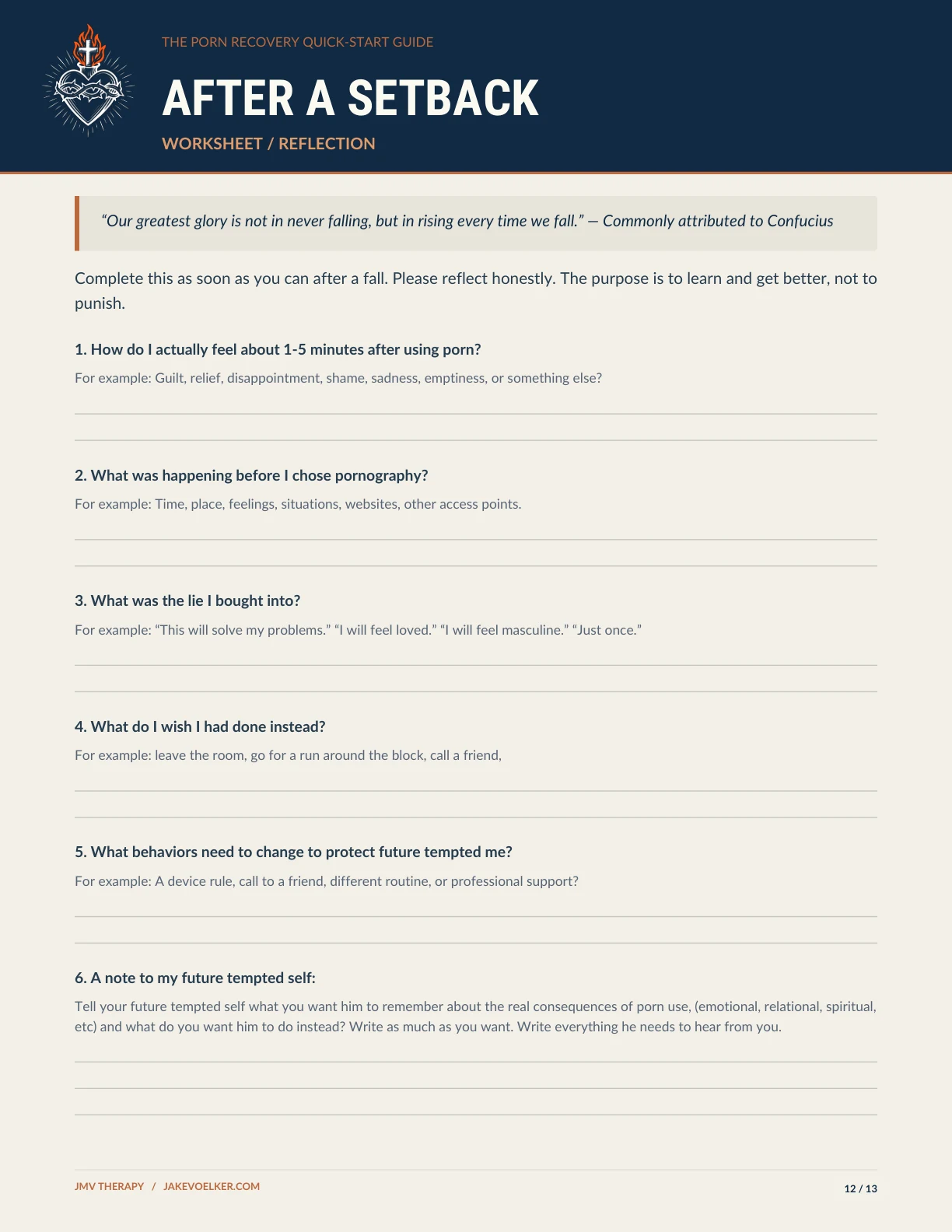 Page 12 · After a SetbackClick to download the full guide
 We take it seriously.
But we also learn from it.
A relapse can tell us something.
What was happening beforehand?
What trigger did we miss?
Where did the plan break down?
What needs to change?
Writing about the setback can help you notice what you were feeling, what happened before the temptation, and what pornography seemed to promise in that moment. Try journaling without attacking yourself.
Then write a note to your future tempted self. Remind him of the real consequences you want to keep in view and what you want him to do instead. We can use what you learn to connect the first moment of temptation with what followed, understand the pattern, and plan a response for next time.
The goal is not to excuse the behavior.
It is to make sure failure becomes information rather than simply another reason to feel ashamed.
A setback does not have to become a return to the old pattern.
You can stop.
Learn.
Adjust.
And keep moving.
Porn Addiction Therapy in St. Louis Park, Minneapolis & the Twin Cities
I work with men who want to stop using pornography and understand why their previous attempts at quitting have not lasted.
My approach combines practical behavior change with deeper therapeutic work.
We look at triggers, habits, your environment, emotional regulation, shame, relationships, negative beliefs, accountability, and the kind of life you want to build beyond pornography.
When appropriate, we can also use EMDR to address painful experiences and beliefs that may be contributing to the cycle.
This is not about giving you another lecture on why you should stop.
You already know why you want to stop.
The work is figuring out how to actually become free enough to live differently.
I provide pornography recovery therapy for men through JMV Therapy in St. Louis Park, Minnesota, serving Minneapolis and the surrounding Twin Cities.
Contact Me About Pornography Recovery Download the free Quick-Start Guide (PDF)